

The Weekly Wealth Watch
August 10, 2026
Is It Really Different This Time?
“Be quick, but don’t hurry.” — John Wooden
The Markets
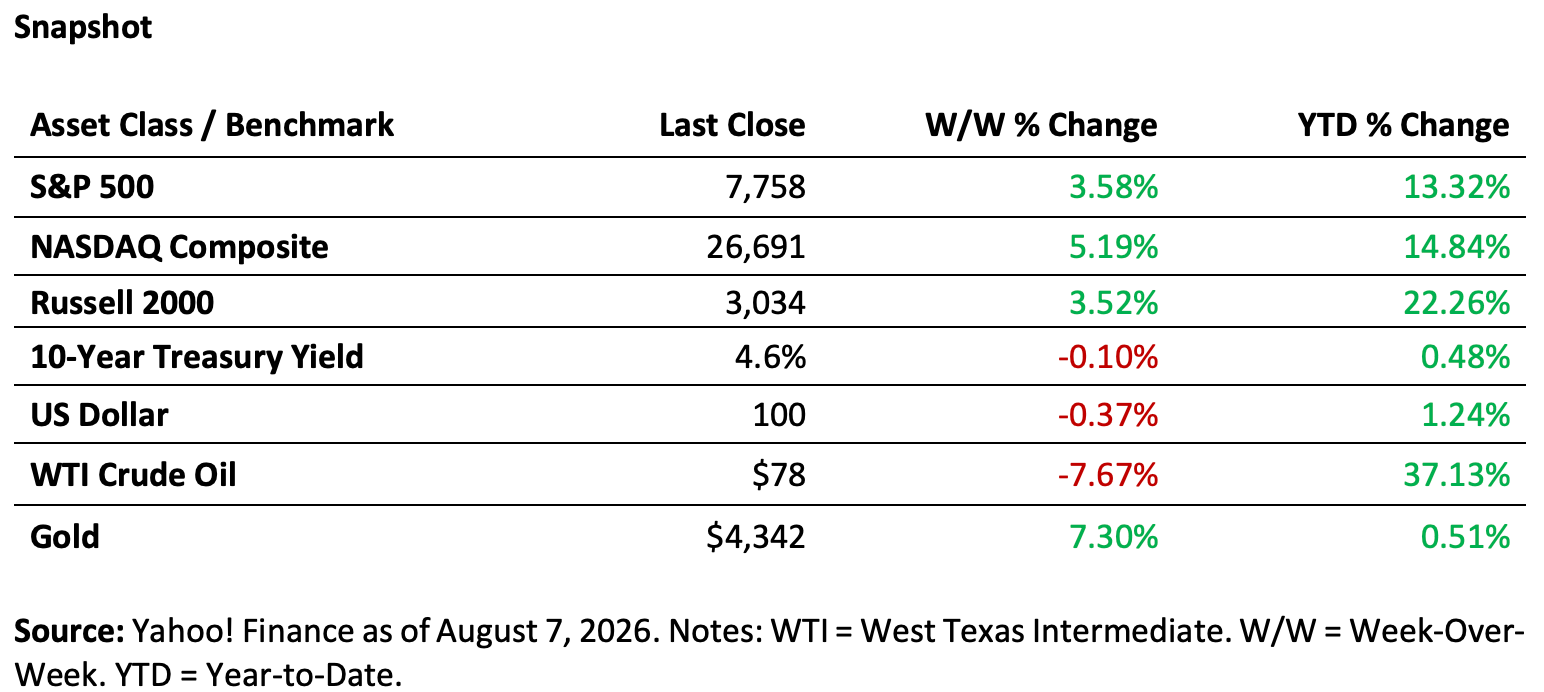
Investors came back from wherever they had been hiding and decided to buy stocks with both hands. The S&P 500 gained 3.58%, the NASDAQ Composite jumped 5.19%, and the Russell 2000 advanced 3.52%. The fact that large-cap technology and smaller companies rallied together is encouraging: this wasn’t simply a handful of mega-cap stocks dragging the indexes higher.
The bond market cooperated. The 10-Year Treasury yield eased to 4.6%, while the U.S. dollar slipped 0.37%. Stocks up, yields down, and a softer dollar generally make for a friendlier financial backdrop—and investors seemed happy to take advantage of it.
Commodities, meanwhile, apparently did not receive the same script. WTI crude oil plunged 7.67%, even though it remains up more than 37% year to date. Gold went the other direction, surging 7.30% for the week. Taken together, the moves suggest markets are balancing enthusiasm about growth and technology with continued demand for diversification and protection.
It was, in short, a decidedly risk-on week for equities—but a fascinatingly mixed one underneath the surface.
AI Is Not Exactly Tiptoeing Into the Room
Everything about the artificial intelligence buildout feels enormous. Data centers are enormous. Capital expenditures are enormous. Demand for compute is enormous. Even the numbers describing the numbers are getting enormous.
Consensus estimates cited in the supplied research put 2027 cloud capital spending at approximately $1.2 trillion, up about 30%.
And there is little indication that the people writing those checks have suddenly become shy.
Comparing AI with the internet is tempting, but the better historical analogy may eventually prove to be something even larger—a general-purpose technology such as the steam engine or electricity that ultimately changes how almost every industry operates. That is still only a possibility, but the speed of adoption makes the comparison worth considering.
Unlike some previous technology booms, this is not simply a case of “build it and hope somebody comes.” The customers have already arrived.
ChatGPT reached 100 million active users in roughly two months. The World Wide Web took more than seven years to reach the same milestone.
That is less an adoption curve and more an adoption rocket.
Nearly a Billion People—and We May Still Be Early
The internet now has roughly five billion users. Meanwhile, Microsoft estimates that 17.8% of the world’s working-age population was using generative AI in the first quarter of 2026, up from 16.3%. Microsoft reports particularly striking adoption in the UAE, where usage reached 70.1%, while the U.S. stood at 31.3%.
Those numbers raise an interesting question: if AI has already reached this many people this quickly, what happens when the technology becomes materially better, cheaper, easier to use, and embedded in products people already use every day?
Nobody knows.
And that is precisely why the opportunity—and the risk—are both so interesting.
AI Doesn’t Have One Cycle. It Has Several.
Investors naturally want one neat answer to the question: When does the AI cycle peak?
Unfortunately, AI did not receive the memo that Wall Street prefers tidy spreadsheets.
- Memory and components
- GPUs and accelerators
- Financing and credit
- Physical infrastructure
- Adoption and productivity
They won’t necessarily peak together. A semiconductor cycle could cool while data-center construction remains strong. Infrastructure spending could slow while businesses are only beginning to figure out how to use all that computing power productively. Credit conditions could change before either one. These cycles can operate on dramatically different timelines—from component and GPU replacement cycles to multi-decade physical infrastructure and slower technology-adoption curves.
That makes declaring “the AI boom is over” considerably harder than spotting the end of a single product cycle.
The Mean-Reversion Question
Investors know the rule: trees don’t grow to the sky.
Eventually, extraordinary growth slows. Margins normalize. Competitors arrive. Capital becomes less scarce. Valuations come back toward earth.
That’s mean reversion, and pretending it doesn’t exist is usually expensive.
But there is another possibility worth considering: What if it simply takes longer than expected?
What if earnings continue growing at an unusually strong pace for another 24 months? What if margins remain elevated for another two or three years? If that happens, markets could continue grinding higher—and investors waiting patiently for everything to become “normal” could find themselves waiting for quite a while.
This is where investing becomes uncomfortable. Betting that today’s extraordinary trends continue indefinitely is risky. Betting aggressively against a powerful trend simply because it has already lasted a long time is risky, too.
Our preferred answer is considerably less exciting: diversify, manage position sizes, stay alert, and resist pretending anyone owns a crystal ball.
Sometimes boring is beautiful.
Human Interest: Humans May Be the Slow Part
AI models can process enormous amounts of information almost instantly. Humans and organizations? Not so much.
Researchers who study technology adoption have noted that diffusion is often constrained by the pace at which people, organizations, and institutions change.
That distinction matters. Buying a new piece of software can take five minutes. Redesigning a company around it can take five years.
The history of major technologies is filled with this pattern. The invention comes first. Then comes the much slower process of changing workflows, training people, rebuilding infrastructure, rewriting rules, and figuring out what the invention is actually good for.
In other words, the machines may be moving at AI speed. Humans are still moving at human speed.
And that could mean the productivity story has considerably more runway than the headlines suggest.
Interesting Facts & Figures
- 17.8% of the world’s working-age population was already using generative AI by Q1 2026. In the UAE, usage reached 70.1%.
- ChatGPT reached 100 million users in about two months, compared with more than seven years for the early World Wide Web.
- The internet has grown to approximately five billion users worldwide—an extraordinary reminder that technologies that once seem exotic can eventually become ordinary infrastructure.
- James Smithson, whose fortune created the Smithsonian Institution, never visited the United States. His bequest nevertheless helped create what is now the world’s largest museum, education, and research complex.
On This Day in History – August 10
August 10, 1846: President James K. Polk signed legislation establishing the Smithsonian Institution.The story behind it is almost as interesting as the institution itself. British scientist James Smithson left his fortune to a country he had never visited, asking that an institution be created in Washington for the “increase and diffusion of knowledge.” Congress debated what to do with the money for roughly a decade before finally creating the Smithsonian.
Today, the Smithsonian encompasses 21 museums, the National Zoo, and nine research facilities.
There is something fitting about that anniversary during an AI revolution. In 1846, diffusing knowledge meant museums, libraries, lectures, and scientific research. In 2026, nearly two centuries later, we’re debating what happens when machines can help diffuse knowledge almost instantly.
The tools change. Human curiosity doesn’t.
Sources & Footnotes:
- User-provided Snapshot — Weekly closing levels, week-over-week changes, and year-to-date performance for the S&P 500, NASDAQ Composite, Russell 2000, 10-Year Treasury Yield, U.S. Dollar, WTI crude oil, and gold.
- Investing.com / Morgan Stanley — 2027 cloud capital-spending consensus of approximately $1.2 trillion and projected 30% growth, as cited in the supplied WCG research.
- World Bank / International Telecommunication Union / Our World in Data — Historical internet adoption and worldwide internet-user figures.
- Microsoft Global AI Diffusion Report — Global generative-AI adoption, including 17.8% of the working-age population and country-level adoption rates.
- World Bank — Global working-age population estimates used to contextualize AI adoption.
- SemiAnalysis; UncoverAlpha; NVIDIA/CNBC; NBER; Western Asset; Uptime Institute; Intertek; Brynjolfsson, Rock & Syverson; David (1990) — Research underlying the discussion of memory, GPU, credit, infrastructure, and technology-adoption cycle lengths.
- Microsoft / research on AI diffusion — Commentary on the speed of AI diffusion versus the slower pace of organizational and institutional change.
- Smithsonian Institution and Smithsonian Institution Archives — Founding of the Smithsonian on August 10, 1846, James Smithson’s bequest, and the institution’s history and current scale.
Definitions:
Artificial intelligence (AI): Computer systems designed to perform tasks commonly associated with human intelligence, including analyzing data and generating content.
Capital expenditures (CAPEX):Funds used to acquire, upgrade, or maintain long-term assets such as data centers, servers, networking equipment, and infrastructure.
Cloud capital spending:Capital expenditures by cloud-service providers to build or expand computing, storage, networking, and data-center capacity.
Compute: The processing capacity and related resources used to train and operate AI systems.
GPU / accelerator:A specialized processor capable of performing large numbers of calculations in parallel, including calculations used for AI workloads.
Hyperscaler:A large cloud or data-center operator capable of rapidly expanding computing and storage infrastructure at significant scale.
Mean reversion:The theory that prices, valuations, or financial measures may eventually move back toward longer-term averages.
Diversification:Allocating investments among different assets, sectors, or strategies to reduce concentration risk. Diversification does not guarantee a profit or protect against loss.
Disclosures:
This material is provided for general informational and educational purposes only and is not intended as individualized investment advice, a recommendation, or an offer or solicitation to buy or sell any security or investment product. Readers should consider their own objectives, risk tolerance, and financial circumstances and consult appropriate financial, tax, and legal professionals.
This material contains forward-looking statements, forecasts, consensus estimates, and cycle-length estimates based on assumptions and subject to significant risks and uncertainties. Actual results may differ materially, and there is no assurance that any forecast, trend, or estimate will occur.
Information obtained from third-party sources is believed to be reliable, but its accuracy, completeness, and timeliness are not guaranteed. Data are current only as of the dates cited and may be revised.
Investing involves risk, including the possible loss of principal. Technology, economic, earnings, and market trends can change or reverse unexpectedly. Diversification does not ensure a profit or protect against loss in declining markets.
Securities offered through LPL Financial, Member FINRA/SIPC. Investment Advice offered through WCG Wealth Advisors, LLC, a Registered Investment Advisor. WCG Wealth Advisors, LLC is a separate entity from LPL Financial.
Bond yields are subject to change. Certain call or special redemption features may exist which could impact yield. (118-LPL)
The S&P 500 is a stock market index tracking the stock performance of 500 of the largest companies listed on stock exchanges in the United States. Indexes are unmanaged and cannot be invested in directly. (102-LPL)
The NASDAQ Composite Index measures all NASDAQ domestic and non-U.S. based common stocks listed on The NASDAQ Stock Market. The market value, the last sale price multiplied by total shares outstanding, is calculated throughout the trading day, and is related to the total value of the Index. Indexes are unmanaged and cannot be invested in directly. (112-LPL)
The fast price swings in commodities will result in significant volatility in an investor’s holdings. Commodities include increased risks, such as political, economic, and currency instability, and may not be suitable for all investors. (122-LPL)
There is no guarantee that a diversified portfolio will enhance overall returns or outperform a non-diversified portfolio. Diversification does not protect against market risk. (26-LPL)
The Russell 2000 Index is generally representative of the 2,000 smallest companies by market capitalization in the Russell 3000 index, which represents approximately 10% of the total market capitalization of the Russell 3000 Index. Indexes are unmanaged and cannot be invested in directly. Bonds are subject to market and interest rate risk if sold prior to maturity. Bond values will decline as interest rates rise. Bonds are subject to availability, change in price, call features and credit risk. The fast price swings in commodities will result in significant volatility in an investor’s holdings. Commodities include increased risks, such as political, economic, and currency instability, and may not be suitable for all investors.
Securities offered through LPL Financial, Member FINRA/SIPC. Investment Advice offered through WCG Wealth Advisors, LLC, a Registered Investment Advisor. WCG Wealth Advisors, LLC is a separate entity from LPL Financial.